Sunday, June 23, 2024

German economy minister urges China to shift from coal power

 

German economy minister urges China to shift from coal power
Reuters / Updated: Jun 23, 2024, 14:40 IST
TOI logo

Now Playing
'Leave Lebanon Now': Kuwait's Emergency Message To Citizens

German economy minister urges China to shift from coal power

German Economy Minister Robert Habeck emphasized China's importance in achieving global climate goals and the need for a safe alternative to coal, which dominated 60% of China's electricity supply in 2023.

Read More
German economy minister urges China to shift from coal power

German Vice Chancellor and Economy Minister Robert Habeck visits China

HANGZHOU: German economy minister Robert Habeck said on Sunday that China was indispensable to achieving global climate goals and must find a safe alternative to coal, which accounted for nearly 60% of China's electricity supply in 2023.
Officials told Habeck that China was expanding coal production for security reasons, the minister told reporters in the southern city of Hangzhou, the day after meeting Chinese officials in Beijing.

Poll

Do you think Nikhil Gupta's extradition will affect India-US ties?


"China also imports large amounts of gas and oil and China has already seen what has happened in Europe and Germany in the last two years," he added, referring to the energy crisis triggered by Russia's full-scale invasion of Ukraine.
He said cooperation with China must be strengthened, adding: "Without China it would not be possible to meet the climate targets globally".
"You don't have to teach them that CO2 emissions are bad for the climate. They've got that," Habeck said, adding that it should be possible to achieve the same level of security with fewer coal-fired power plants.
Later, Habeck told students at the university of Zhejiang that the difficulty lay in integrating variable forms of energy such as wind and solar into a system built to work on more predictable fuels, adding: "That is basically my work."


He said that doubling capacities was "the old way" of doing it, but not the most efficient.
China is expanding its coal production but also installed almost 350 gigawatts (GW) of new renewable energy capacity in 2023, more than half the global total.
Habeck said extension of the power grid and use of batteries to store energy could reduce the number of traditionally fuelled power plants needed to meet China's needs, adding that economic growth and climate action were not opposites.
"Transforming the economy to a climate-neutral one is not only good for the climate but creates new opportunities for wealth and growth," Habeck said.

End of Article

FOLLOW US ON SOCIAL MEDIA

Search for

Slide 1 of 20


    Israel’s Iron Dome risks being overwhelmed in all-out war with Hezbollah, says US


    Israel’s Iron Dome risks being overwhelmed in all-out war with Hezbollah, says US

    Peter BeaumontJune 23, 2024
    Israeli soldiers on a highway, with a plume of smoke rising in the distance
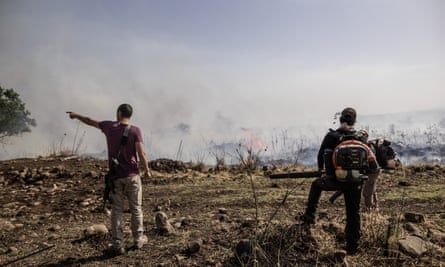
    A smoke plume rises after rockets fired from southern Lebanon landed near Kfar Szold in the Upper Galilee in northern Israel on 14 June.

    Militants in Lebanon can fire 3,000 missiles a day, US officials warn as fears grow that the conflict will escalate

    Israel’s Iron Dome anti-missile batteries risk being overwhelmed in the opening strikes of any significantly escalated conflict with Hezbollah.

    The assessment delivered by US officials late last week, echoing recent analysis by experts in Israel and the United States, comes amid fears that a war with Hezbollah could be a far more dangerous undertaking than the devastating 2006 second Lebanon war, when Israeli bombing caused huge destruction in Lebanon.

    The US and France are leading diplomatic efforts to avert a wider conflict between Israel and Hezbollah, amid fears that escalating rhetoric and exchanges of fire across the border could lead to full-scale war.

    On Friday, Kuwait’s foreign ministry warned its citizens to avoid travelling to Lebanon and urged those already in the country to leave. There are also reports that officials in the Biden administration told an Israeli delegation in Washington that America would offer security assistance in the event of a wider conflict, while António Guterres, the United Nations secretary general, called for “reason and rationality” to avoid potentially catastrophic consequences for the region and the world.

    Since 2006, Hezbollah, the world’s best-armed non-state group, has significantly expanded its arsenal and capabilities, including acquiring suicide drones which Israel has struggled to counter, an anti-aircraft missile capability and a widely expanded array of missiles which experts now believe number between 120,000 and 200,000.

    Fire broke out in 15 places in northern Israel caused by missiles fired from Lebanon on 13 June. Photograph: Anadolu/Getty Images

    While Hezbollah’s general secretary, Sayyed Hassan Nasrallah, has said his group can count on 100,000 armed men, its core military strength probably amounts to around a third of that, but with a significant number having had combat experience in Syria.

    It is the scale of Hezbollah’s missile arsenal, however, and an operational doctrine for their use in a major conflict with Israel, that is likely to be most challenging.

    While the majority of Hezbollah’s stockpile comprises tens of thousands of unguided missiles – both short and long range – since 2006 it has acquired hundreds of guided ballistic missiles, with the ability to fire them from hardened bunkers and from mobile launchers.

    Complicating the issue has been Hezbollah’s increasing and effective use of drones, including kamikaze weapons, which Israel’s existing air defences have struggled to counter.

    A three-year research project by Reichman University’s Institute for Counter-Terrorism in Israel, completed not long before the Hamas attack on 7 October, concluded Hezbollah could fire up to 3,000 missiles a day, a rate that could be sustained for up to three weeks. Its key aim would be to force the collapse of Israel’s air defences.

    “The expectation of the public and of a significant portion of the leadership, that the Israeli Air Force and effective Israeli intelligence systems will succeed in preventing most of the rocket attacks on Israel, will be shattered,” the report said. “This is also the case regarding the public’s belief that the threat of Israeli retaliation or a substantial Israeli attack on significant Lebanese assets will force Hezbollah to cease fire or significantly impair their ability to continue attacking Israeli territory.”

    According to a recent briefing paper assessing Hezbollah’s rocket capability prepared by the Center for Strategic and International Studies, a US thinktank, “finding and destroying Hezbollah’s rocket and missile capabilities would involve an enormous reconnaissance-strike effort”.

    “Hezbollah’s rocket and missile arsenal also includes long-range missiles,” the paper adds. “These are also likely to be used mainly in a coercive capacity, with Hezbollah undertaking long-range strikes against Israeli population centres to undermine Israeli support for the war.”

    The most serious challenge, experts believe, is likely to be the sheer number of incoming missiles fired in waves deliberately designed to overwhelm Israel’s air defence systems.

    “It would be a tall order for Israeli air defences to confront the widespread rocket arsenal coming from the north,” Seth G Jones, an analyst at the thinktank in Washington, said last week, echoing warnings from Pentagon officials. “We assess that at least some” Iron Dome batteries “will be overwhelmed”, a senior Biden administration official told CNN, which also reported that Israel was moving extra air defence assets to the north.

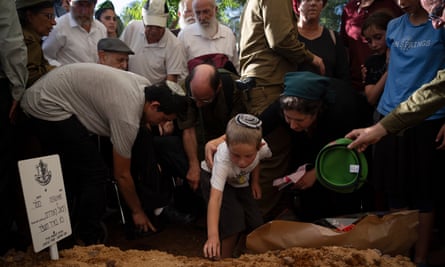
    The funeral of a reservist in the West Bank settlement of Kfar Etzion on 6 June. Rafael Kauders, 39, was killed during a drone attack launched by Hezbollah. Photograph: Léo Corrêa/AP

    Israel has about 10 Iron Dome batteries each with about four individual launchers, each battery connected to a radar system that detects incoming missiles. Like all systems, however, it is physically limited by how many threats it can engage simultaneously.

    Hezbollah’s upgraded missile capability has triggered warnings about the threat posed to Israel’s civil resilience, prompting plans for coping with mass casualties if war breaks out. Not everyone is convinced that Israel’s military and political leadership has fully grasped the risks.

    Speaking at a conference last week Shaul Goldstein, head of Noga, which manages Israel’s electrical systems, warned: “We are not ready for a real war. We live in a fantasy world, in my eyes.” He added that Israel would be “uninhabitable” after 72 hours without power. “You look at all of our infrastructure, the optical fibres, the ports – and I won’t go into the sensitive things – we are not in a good place.” However, he appeared to walk back some comments in a later radio interview after other experts criticised his remarks.

    In Gaza City, meanwhile, dozens of Palestinians have been killed in Israeli airstrikes on two densely populated locations. According to initial reports in the Israeli media, the bombings were aimed at assassinating a very senior Hamas commander.

    Amid initial reports of tens of casualties, including some still buried under the rubble, the Israel Defense Forces said it had struck Hamas “military infrastructure sites”.

    The strikes hit the al-Shati neighbourhood, known as Beach camp, and the al-Tuffah district, which were both struck by significant explosions, killing 38 people, according to Ismail al-Thawabta, director of the Hamas-run government media office. Hamas did not comment on the Israeli claim to have hit its military infrastructure.


    "In 4 Years, Don't Vote, I Don't Care": Trump's Election Appeal


    "In 4 Years, Don't Vote, I Don't Care": Trump's Election Appeal

    Hadriana Lowenkron and Stephanie Lai, BloombergJune 23, 2024
    'In 4 Years, Don't Vote, I Don't Care': Trump's Election Appeal

    Trump has regularly highlighted instances of undocumented migrants committing violent crime.

    Former President Donald Trump told evangelical voters they needed to boost their turnout at the polls as he sought in a pair of Saturday campaign events to shore up - and expand - his base.

    Trump spoke Saturday afternoon to the Faith and Freedom Coalition conference in Washington, a gathering of evangelical conservatives who have provided a bedrock of support for his three presidential bids. Later, the presumptive Republican presidential held a rally in North Philadelphia as part of his effort to make inroads with Black voters in the pivotal swing state of Pennsylvania.

    Trump told his supporters that to defeat President Joe Biden, he needed them "to turn out in the largest numbers ever."

    "The evangelicals and Christians, they don't vote as much as they should, I don't know if you know that," Trump said. "They go to church every Sunday, but they don't vote."

    Trump went on to complain that gun-rights activists also didn't vote in high enough numbers, and said ballot drop-off boxes should be placed inside of churches.

    "You got to get out, just this time," Trump continued. "I don't care in four years - you don't have to vote, OK? In four years, don't vote, I don't care."

    Trump received a hero's welcome from the organization, founded by conservative activist Ralph Reed, despite a presidency during which he took little action on many of the group's key priorities, from combating same-sex marriage to ending the legalization of medical marijuana.

    Still, Trump's push to appoint Supreme Court justices who overturned Roe v. Wade - along with his embrace of culture-war clashes - have cemented his appeal with evangelicals and his standing as the leader of the Republican Party.

    Trump's occasionally chiding effort to convert the enthusiasm at the Washington event into votes at the ballot box underscored the extent his hopes for a second term rely on motivating dedicated supporters. Polls show wide swaths of moderate swing voters disappointed with both candidates and considering third-party options or disinclined to vote.

    "I think it's sort of a protest. You're so angry about what's happening," Trump said. "Do you know the power you'd have if you would vote?"

    Even as Trump's political operation focuses on turning out dedicated conservatives, he's also seeking to appeal to Black and Latino voters - who have traditionally supported Democratic presidential candidates - but have felt the brunt of post-pandemic inflation. Trump's rally at Temple University in Philadelphia came just days after a visit to a Black church in Detroit.

    "We will also work to lift up Black, Hispanic and other communities in Philadelphia and all across the United States," Trump said.

    Polls show Biden's standing among minority voters has softened, possibly providing an opening to Trump and Republicans who hope to draw just enough support to win close battleground states.

    Trump's efforts have been complicated by his frequent descriptions of cities with large Black populations as crime-ridden and failing, as he did last week while discussing Milwaukee, which will host the Republican National Convention, with GOP lawmakers.

    In Philadelphia, Trump lamented that "convenience stores are closing down left and right" and described statistics showing the city's murder rate falling substantially as "fake news." As of April, homicides in Philadelphia were down by more than a third compared to the prior year.

    Trump also flashed his propensity for controversy at both stops, telling attendees that he had pitched Dana White, the head of Ultimate Fighting Championship, on an event that would pit the champion of his league against a competing "migrant league of fighters."

    Trump has regularly highlighted instances of undocumented migrants committing violent crime and warned immigrants were "poisoning the blood of our country," while critics - including Biden - have argued the rhetoric is racially coded.

    "I think the migrant guy might win," Trump said. "That's how tough they are. He didn't like that idea too much, but actually not the worst idea I've ever had."

    Biden won Pennsylvania in 2020, and his hopes of carrying the state in November's rematch with Trump will hinge in part on his ability to turn out Black voters and hold on to working-class voters in the state. A Bloomberg News/Morning Consult poll in May found Trump leads Biden 48% to 46% in Pennsylvania.

    The state has become a focal point for his reelection bid. According to an internal memo from the Trump allied super-PAC, Make America Great Again Inc., the group has and will continue to center its efforts and funding across Pennsylvania.

    More broadly, Biden has also struggled to sell blue-collar workers, important in states including Michigan, on his economic agenda.

    Trump has been ramping up his campaigning after becoming the first former president convicted of a felony, in his New York hush-money trial. He has also managed to use the conviction to boost his war chest, with the campaign raising $141 million in May, surpassing the $85 million Biden raised that month.

    Trump's visit to Washington on Saturday is his second this month. Last week, he returned to Capitol Hill for the first time since the Jan. 6, 2021, attack on the US Capitol by supporters looking to block certification of the 2020 election, meeting with House and Senate Republicans.

    (Except for the headline, this story has not been edited by NDTV staff and is published from a syndicated feed.)